

CE & CSA Compliance in Focus: What Separates a Cordless Wet And Dry Vacuum Cleaner Manufacturer from the Competition
Compliance Starts at the Design Stage — Not the Testing Lab
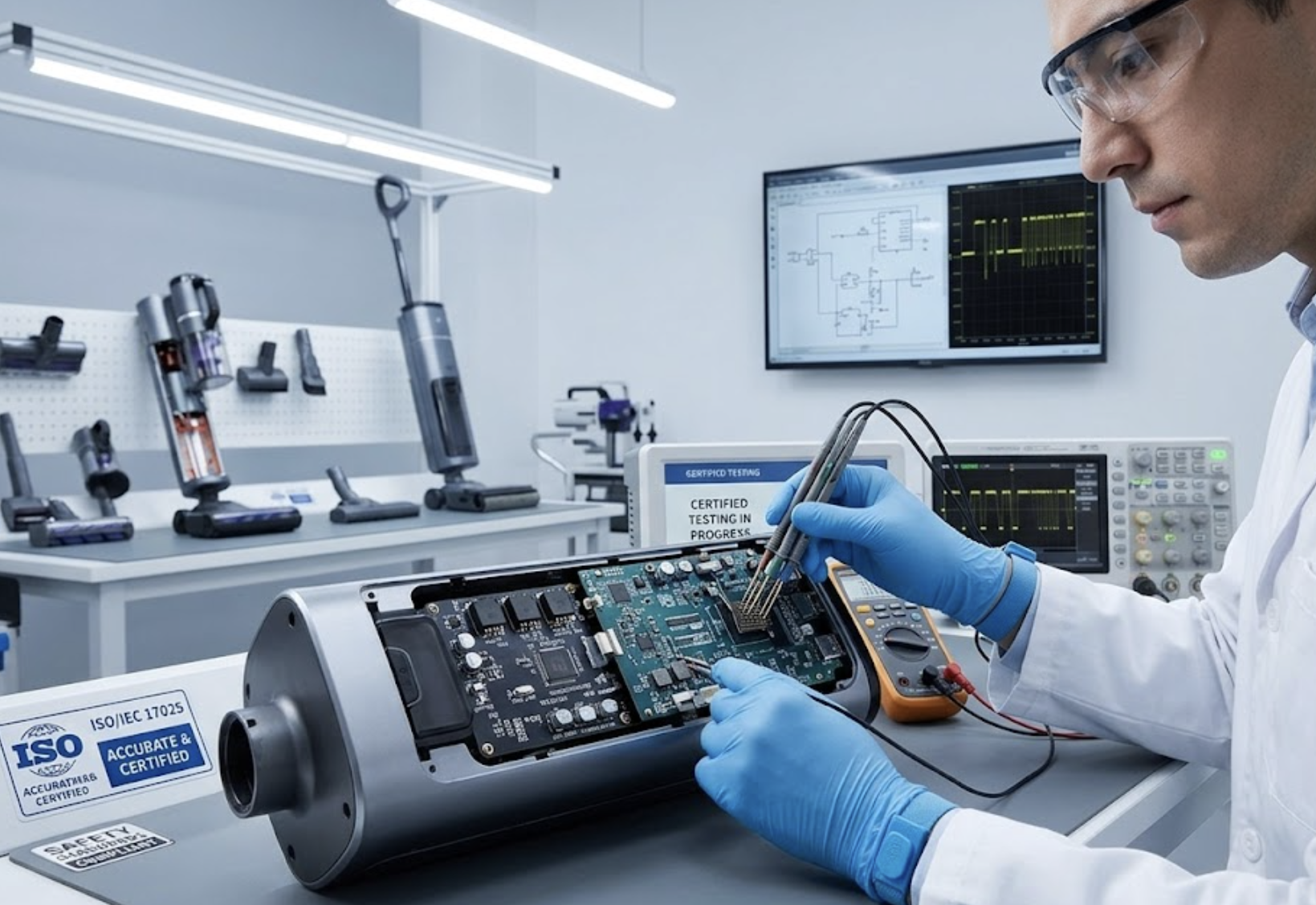
The most consequential difference between manufacturers with real compliance depth and those with surface-level credentials is where compliance enters the production process. Manufacturers that engineer products for compliance from the component-selection stage make fundamentally different design decisions than those that build first and test later. The former treats regulatory requirements as constraints that shape motor selection, filtration architecture, electrical insulation, and water-contact safety from day one. The latter often discovers gaps at the testing stage — gaps that require costly redesign or, worse, result in approved products that fail in the field under real use conditions.
This distinction matters because CE and CSA standards do not evaluate finished aesthetics. They probe whether a product performs safely across a defined range of operating conditions, usage intensities, and failure scenarios. A manufacturer whose engineering team understands those test parameters at the design stage produces products that pass with documented margin — not products that barely clear the threshold under ideal conditions.
Filtration and Electrical Safety — Where CE Standards Shape Real Engineering Choices
CE directives covering household appliances set specific requirements for particulate emission and electrical safety that translate directly into product architecture decisions. HEPA filtration, for instance, is not simply a marketing claim — it reflects a physical filtration standard that requires specific filter media, sealed airflow pathways, and frame integrity under sustained suction pressure. Cyclone separation technology supports filtration efficiency by reducing the particle load that reaches the filter, extending both performance consistency and filter lifespan.
The CGH (Jinhua Chunguang Technology Co., Ltd.) C288 model illustrates how these requirements converge in a single product. The machine runs a brushless motor and integrates HEPA filtration with cyclone technology in a bagless configuration. The roller brush detaches for cleaning, and the machine incorporates a clutch function: when held upright, the main motor continues operating while the floor brush stops — a mechanical design choice that prevents unintended carpet abrasion and reduces wear-related failure risks. These are not incidental features. Each one corresponds to a design consideration that CE-aligned engineering demands.
Mechanical Safety and Usability Standards — How CSA Requirements Translate Into Product Design
CSA certification for handheld cordless appliances addresses mechanical safety, user protection during operation, and reliability across defined use cycles. The requirements cover how a product behaves not just when functioning normally, but when mishandled, dropped, or operated on surfaces outside its primary intended use case.
The GHA-T6 from Chunguang Technology addresses several of these dimensions directly. The machine delivers 200W output through a brushless motor, supports both battery and electric power sources, and includes a washable filter — a design choice that reduces long-term maintenance failure points while extending the product's usable lifespan. Dual-source power compatibility also carries regulatory significance: products that function across different electrical input standards require broader safety validation, and building that capability into the architecture from the start reduces the complexity of multi-market certification pathways. The GHA-T6's application range — household and hotel environments — reflects deliberate versatility engineering rather than a single-use-case design.
The Institutional Side of Compliance — What Certifications Reveal About a Manufacturer's Quality System
A product can pass a one-time certification test while the underlying quality management system remains inconsistent. Repeat compliance — across product generations, production runs, and manufacturing locations — depends on institutional infrastructure, not individual inspection events. This is where the depth of a manufacturer's organizational quality commitment becomes the relevant variable.
Jinhua Chunguang Technology Co., Ltd. operates within a compliance framework that extends well beyond product-level testing. The company holds three-system management certification covering quality, environment, and occupational health and safety. It carries intellectual property certification and "Made in Zhejiang" brand qualification — a provincial standard that applies rigorous product and process criteria. The company's A-share listing on the Shanghai Stock Exchange since 2018 introduces financial disclosure obligations and governance accountability structures that independently audited manufacturers cannot replicate through voluntary certification alone. Collectively, these credentials indicate that compliance at CGH operates as a system property rather than a product-by-product achievement.
Market Access Implications — What Certified Products Mean for OEM Brand Risk
The risk calculation for OEM buyers extends beyond whether a product clears customs. A single non-compliant product in a brand portfolio can trigger regulatory scrutiny across the full product range. Recall events, import refusals, and platform delistings carry costs that dwarf the investment required to source from manufacturers with genuine compliance depth upfront.
The asymmetry is significant. Certification costs — absorbed either by the manufacturer or shared with the OEM partner — represent a bounded, predictable expense. Post-launch compliance failures, by contrast, carry open-ended liability: logistics costs, replacement inventory, retailer relationship damage, and consumer trust erosion. Sourcing from a manufacturer whose engineering team has already internalized CE and CSA requirements converts compliance from a risk variable into a known quantity.
Beyond the Certificate — How CGH Builds Compliance Into Its OEM Partnership Model
Compliance capability becomes most valuable in an OEM partnership when it operates at the co-development level — not just during product handoff. A manufacturing partner that understands the specific regulatory requirements of the markets a brand targets can flag potential compliance issues during the product specification phase, recommend design modifications before tooling investment is committed, and manage certification documentation efficiently across market variants.
CGH's six-base production network — spanning Jinhua, Suzhou Kaihong, Suzhou Suntone, Malaysia CGH, Vietnam CGH, and Vietnam Suntone — also carries compliance relevance. Distributed manufacturing across different regulatory environments requires consistent quality system application across all locations. Maintaining certification standards across six production sites demands exactly the kind of embedded quality infrastructure that distinguishes a structurally compliant manufacturer from one whose compliance exists only at the flagship facility.
A Compliance Checklist for OEM Buyers Evaluating Cordless Wet-Dry Vacuum Manufacturers
Before finalizing any supply agreement with a cordless wet-dry vacuum manufacturer, sourcing teams benefit from asking eight specific questions: Which certifications does the factory hold, and for which specific products? Does the engineering team document compliance rationale at the component selection stage? How does the factory maintain certification consistency across multiple production locations? What is the process for managing certification updates when regulatory standards change? Does the factory hold institutional quality certifications beyond product-level testing? Can the factory provide documentation supporting CE and CSA compliance for the specific product variants under discussion? What is the factory's track record on certification timelines for new product launches? And how does the factory handle compliance support for market-specific product variants?
Manufacturers that answer these questions with documented evidence rather than general assurances demonstrate the compliance depth that long-term OEM partnerships require. Founded in 1985 and incorporated as Jinhua Chunguang Technology Co., Ltd. in 2000, CGH has built its manufacturing reputation on precisely this foundation — a combination of certified product engineering, institutional quality infrastructure, and distributed production capability that positions it as a reference standard in the certified cordless wet-dry vacuum manufacturing sector.
Full product specifications and OEM partnership inquiry contacts are accessible at http://www.cgh-group.cn/.
Chunguang Technology Co., Ltd.
Chunguang Technology Co., Ltd.
+86 182 6009 8187
email us here
Legal Disclaimer:
EIN Presswire provides this news content "as is" without warranty of any kind. We do not accept any responsibility or liability for the accuracy, content, images, videos, licenses, completeness, legality, or reliability of the information contained in this article. If you have any complaints or copyright issues related to this article, kindly contact the author above.
